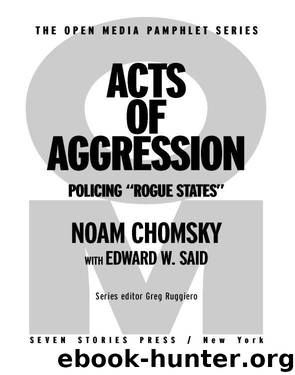
Acts of Aggression by Noam Chomsky
Author:Noam Chomsky
Language: eng
Format: epub
Publisher: Seven Stories Press
Published: 2010-06-24T04:00:00+00:00
MORE ON “THE DEBATE”
That Saddam is a criminal is undoubtedly true, and one should be pleased, I suppose, that the United States and Britain, and mainstream doctrinal institutions, have at last joined those who “prematurely” condemned U.S./U.K. support for the mass murderer. It is also true that he poses a threat to anyone within his reach. On the comparison of the threat with others, there is little unanimity outside the United States and Britain, after their (ambiguous) transformation from August 1990. Their 1998 plan to use force was justified in terms of Saddam’s threat to the region, but there was no way to conceal the fact that the people of the region objected to their salvation, so strenuously that governments were compelled to join in opposition.
Bahrein refused to allow U.S./British forces to use bases there. The president of the United Arab Emirates described U.S. threats of military action as “bad and loathsome,” and declared that Iraq does not pose a threat to its neighbors. Saudi Defense Minister Prince Sultan had already stated that “We’ll not agree and we are against striking Iraq as a people and as a nation,” causing Washington to refrain from a request to use Saudi bases. After Annan’s mission, long-serving Saudi foreign minister Prince Saud al-Faisal reaffirmed that any use of Saudi air bases “has to be a U.N., not a U.S. issue.”
An editorial in Egypt’s quasi-official journal, Al Ahram, described Washington’s stand as “coercive, aggressive, unwise and uncaring about the lives of Iraqis, who are unnecessarily subjected to sanctions and humiliation,” and denounced the planned U.S. “aggression against Iraq.” Jordan’s Parliament condemned “any aggression against Iraq’s territory and any harm that might come to the Iraqi people”; the Jordanian army was forced to seal off the city of Maan after two days of pro-Iraq rioting. A political science professor at Kuwait University warned that “Saddam has come to represent the voice of the voiceless in the Arab world,” expressing popular frustration over the “New World Order” and Washington’s advocacy of Israeli interests.
Even in Kuwait, support for the U.S. stance was at best “tepid” and “cynical over U.S. motives,” the press recognized. “Voices in the streets of the Arab world, from Cairo’s teeming slums to the Arabian Peninsula’s shiny capitals, have been rising in anger as the American drum-beat of war against Iraq grows louder,” Boston Globe correspondent Charles Sennott reported.
The Iraqi democratic opposition was granted a slight exposure in the mainstream, breaking the previous pattern. In a telephone interview with the New York Times, Ahmed Chalabi reiterated the position that had been reported in greater detail in London weeks earlier: “Without a political plan to remove Saddam’s regime, military strikes will be counter-productive,” he argued, killing thousands of Iraqis, leaving Saddam perhaps even strengthened along with his weapons of mass destruction and with “an excuse to throw out UNSCOM [the U.N. inspectors],” who have in fact destroyed vastly more weapons and production facilities than the 1991 bombing. U.S./U.K. plans would “be worse than nothing.” Interviews
Download
This site does not store any files on its server. We only index and link to content provided by other sites. Please contact the content providers to delete copyright contents if any and email us, we'll remove relevant links or contents immediately.
| Anthropology | Archaeology |
| Philosophy | Politics & Government |
| Social Sciences | Sociology |
| Women's Studies |
The Secret History by Donna Tartt(19294)
The Social Justice Warrior Handbook by Lisa De Pasquale(12224)
Thirteen Reasons Why by Jay Asher(8995)
This Is How You Lose Her by Junot Diaz(6955)
Weapons of Math Destruction by Cathy O'Neil(6362)
Zero to One by Peter Thiel(5864)
Beartown by Fredrik Backman(5839)
The Myth of the Strong Leader by Archie Brown(5552)
The Fire Next Time by James Baldwin(5503)
How Democracies Die by Steven Levitsky & Daniel Ziblatt(5271)
Promise Me, Dad by Joe Biden(5189)
Stone's Rules by Roger Stone(5130)
A Higher Loyalty: Truth, Lies, and Leadership by James Comey(5017)
100 Deadly Skills by Clint Emerson(4972)
Rise and Kill First by Ronen Bergman(4837)
Secrecy World by Jake Bernstein(4798)
The David Icke Guide to the Global Conspiracy (and how to end it) by David Icke(4771)
The Farm by Tom Rob Smith(4549)
The Doomsday Machine by Daniel Ellsberg(4542)
